Key Takeaways:
- Phoenix housing market likely to shift toward balance in 2026 with increased inventory and stabilizing prices
- Mortgage rates projected to decrease, improving affordability for first-time buyers
- East Valley and West Valley submarkets expected to see continued development and appreciation
- Technology and AI integration will streamline transactions, benefiting both buyers and sellers
- Rental market will remain strong with growing family-focused segment
Introduction: The Evolving Phoenix Real Estate Landscape
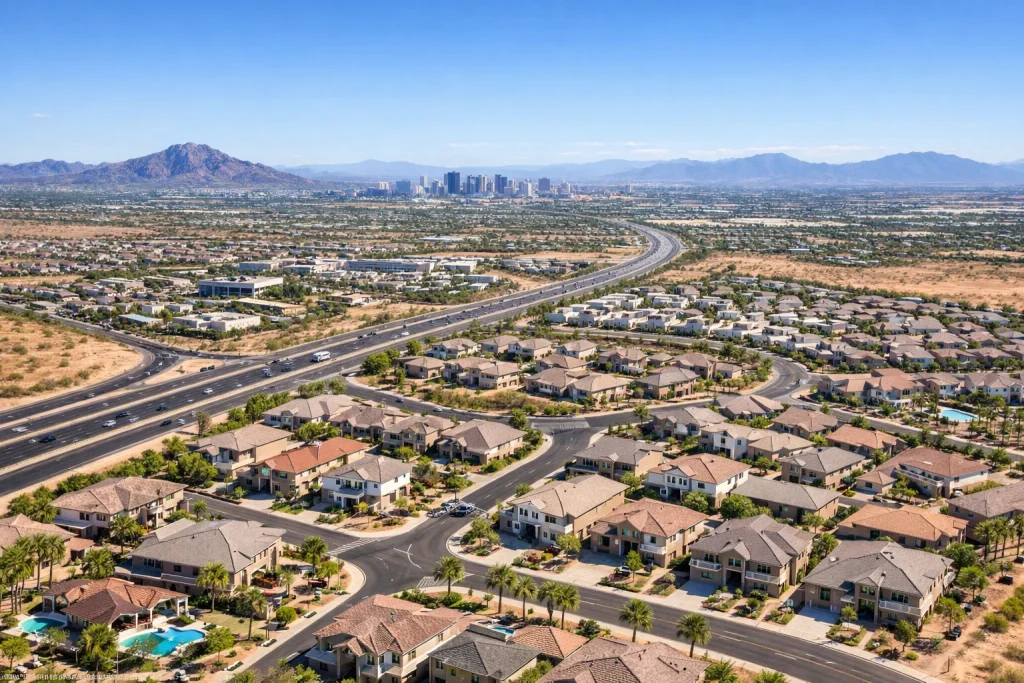
The Phoenix housing market is approaching a significant transition period as we look toward 2026. After years of extreme price appreciation following the pandemic housing boom, economic indicators suggest the market is beginning to normalize. Current data shows Phoenix metro median home prices hovering around $450,000 – a figure that’s expected to see modest but stable growth through 2026.
This evolution is being driven by several interconnected factors. The Phoenix metro area continues to attract residents from higher-cost markets like California and Washington, though at a more sustainable pace than the pandemic-era migration surge. Meanwhile, housing inventory levels are gradually increasing as new construction projects come online and economic conditions shift.
For potential buyers, sellers, and investors, understanding these dynamics is crucial for making informed decisions. The Phoenix housing market in 2026 won’t mirror either the frenzied seller’s market of 2021-2022 or the uncertainty of 2023-2024. Instead, it’s evolving into a more balanced environment with unique opportunities for different market participants.

Market Overview: Key Trends Shaping Phoenix Real Estate in 2026
The Phoenix housing market in 2026 will be defined by several critical trends that are already beginning to emerge. Economic indicators point to a period of relative stability after the volatility of recent years, with the market finding a new equilibrium that differs significantly from both the boom and correction phases.
First, Phoenix’s population growth continues to drive housing demand, though at a more moderate pace. Migration patterns show approximately 85,000 new residents arriving annually to the Phoenix metro area, creating sustained housing needs across all segments. This population increase, while slower than peak pandemic levels, remains well above the national average.
Second, job growth in Phoenix is diversifying beyond traditional sectors. The city is attracting technology companies, advanced manufacturing, and healthcare organizations that bring higher-wage jobs. Major employers like Taiwan Semiconductor Manufacturing Company (TSMC), Amazon, and numerous healthcare systems are expanding their footprint, creating salary growth that supports housing demand in various price points.
Third, new construction is gradually addressing supply constraints. Builders are focusing on middle-market housing, especially in the East Valley and West Valley communities, helping to ease the severe inventory shortages that characterized the early 2020s. By 2026, completed projects in communities like Gilbert, Queen Creek, Buckeye, and Surprise will have significantly increased available housing stock.
Fourth, Phoenix’s housing market is maturing in response to economic reality. Rising construction costs and land prices are pushing developers to create higher-density options, including townhomes and smaller-lot single-family homes, that maintain relative affordability while maximizing land use.
Fifth, water concerns are shaping development patterns. As drought conditions persist across the Southwest, water availability is increasingly influencing where and how new housing is built. Projects with water-efficient designs are gaining priority in permitting processes, shifting the market toward more sustainable development models.
Price Projections: What to Expect from Phoenix Home Values
The trajectory of home prices in the Phoenix market through 2026 shows signs of moderation after the extreme volatility of recent years. Economic indicators and housing market data suggest Phoenix home values will stabilize and then begin a period of modest appreciation, with variations across different neighborhoods and property types.
Current projections indicate the median home price in Phoenix could reach approximately $470,000-$490,000 by 2026, representing annual appreciation of 2-4% – a sustainable pace that aligns with historical norms rather than the double-digit increases seen during the pandemic boom.
This price stabilization benefits buyers who were previously priced out of the market while still providing reasonable equity growth for current homeowners. The days of 20-30% year-over-year price jumps appear to be behind us, replaced by more predictable and sustainable growth patterns.
| Phoenix Submarket | Current Median Price (2024) | Projected 2026 Median Price | Expected Appreciation |
|---|---|---|---|
| Scottsdale | $850,000 | $910,000 | 7% |
| Central Phoenix | $450,000 | $480,000 | 6.7% |
| Gilbert | $550,000 | $590,000 | 7.3% |
| Mesa | $425,000 | $455,000 | 7.1% |
| Glendale | $400,000 | $425,000 | 6.3% |
| Chandler | $520,000 | $560,000 | 7.7% |
| Surprise | $420,000 | $450,000 | 7.1% |
| Queen Creek | $490,000 | $535,000 | 9.2% |
The table highlights significant geographic variation across Phoenix neighborhoods. Established areas like Scottsdale will maintain premium pricing while showing moderate growth. Meanwhile, developing areas in the East Valley, particularly Queen Creek, show stronger appreciation potential as infrastructure improvements and commercial development enhance their appeal.
For buyers, this price stabilization paired with improving mortgage rates creates a window of opportunity that hasn’t existed in recent years. The affordability equation is shifting in their favor, though prices remain significantly higher than pre-pandemic levels.

Technology and AI Impact on Real Estate
By 2026, technology and artificial intelligence will fundamentally transform how Phoenix buyers and sellers experience real estate transactions. These advances won’t replace human agents but will streamline processes, reduce friction points, and create more informed decision-making.
For buyers in Phoenix, AI-powered search tools will deliver hyper-personalized property recommendations based on lifestyle preferences, commute patterns, and even subtle design preferences learned from their browsing behavior. Virtual tours will become more immersive, allowing potential buyers to “walk through” dozens of properties before selecting those worthy of in-person visits – particularly valuable in Phoenix’s summer heat.
Sellers in Phoenix will benefit from AI-driven pricing models that analyze hyperlocal market data to recommend optimal listing prices. Additionally, predictive analytics will identify the most likely buyer demographics for specific properties, allowing for targeted marketing campaigns that reduce days on market.
- AI-powered valuation tools will provide more accurate estimates by analyzing hundreds of property-specific variables
- Automated transaction management systems will track document status and deadlines, reducing closing timelines by 30-40%
- Smart contracts using blockchain technology will increase security while decreasing paperwork
- Virtual staging technology will allow sellers to digitally showcase different design options for the same space
- Predictive maintenance AI will help sellers identify and address potential inspection issues before listing
These technological advances are particularly relevant in Phoenix, where the market includes many out-of-state buyers purchasing sight-unseen or investors managing properties remotely. By 2026, the adoption rate of these technologies will reach critical mass, creating expectations for more efficient, transparent, and data-driven real estate experiences.
Supply and Demand Dynamics: Phoenix Housing Inventory 2026
The Phoenix housing market in 2026 will feature significantly improved inventory levels compared to the severe shortages of 2021-2023. This inventory expansion represents one of the most fundamental shifts in market dynamics, creating more balanced conditions between buyers and sellers.
Housing inventory in Phoenix is projected to reach 3-4 months of supply by 2026 – approaching the 4-6 month range that typically defines a balanced market. This marks a substantial increase from the sub-1-month levels seen during the pandemic and early post-pandemic periods that heavily favored sellers and drove bidding wars.
- Factors increasing inventory by 2026:
- New construction pipeline maturing across the Phoenix metro area
- Baby boomer homeowners beginning to downsize or relocate
- Improved financing options enabling move-up buyers to list starter homes
- Fewer investors competing with traditional homebuyers
- Factors constraining inventory growth:
- Continued net in-migration to the Phoenix metro area
- Persistent land and material cost challenges
- Water availability concerns limiting development in certain areas
- Many homeowners with low-rate mortgages reluctant to sell
This inventory expansion will significantly impact market dynamics. Average days on market in Phoenix is expected to increase from the current 30-45 days to approximately 60-75 days by 2026 – still indicating a healthy market, but one that gives buyers more time to make decisions.
For buyers in Phoenix, increased inventory means more options, less pressure to make rushed decisions, and greater negotiating leverage. The extreme competition that characterized the market in recent years will continue to ease, with fewer multiple-offer situations and less pressure to waive contingencies or offer above asking price.
Sellers will need to adjust expectations accordingly, recognizing that properly priced homes will still sell, but often with longer marketing periods and more balanced negotiations. The days of listing on Friday and accepting offers by Sunday will largely be behind us by 2026.
New Construction and Development Outlook
New home construction will play a crucial role in balancing the Phoenix housing market by 2026, with builders responding to persistent demand despite the challenges of rising costs and water constraints. The development landscape shows distinct patterns emerging across Phoenix neighborhoods, with activity concentrated in specific growth corridors.
Builders are projected to deliver approximately 25,000-30,000 new housing units annually through 2026, helping to address the housing shortage that has contributed to price pressures. This construction level represents a moderate increase from current production but remains below the peak levels seen in previous building cycles.
| Development Zone | Projected Units (2024-2026) | Housing Types | Completion Timeline |
|---|---|---|---|
| East Valley (Queen Creek/San Tan) | 15,000+ | Single-family, townhomes | Ongoing through 2026 |
| West Valley (Buckeye/Surprise) | 12,000+ | Single-family, master-planned | Major phases 2025-2026 |
| North Phoenix/Deer Valley | 8,000+ | Mixed-use, multi-family | Multiple phases through 2026 |
| Pinal County Growth Corridor | 10,000+ | Affordable single-family | Accelerating through 2026 |
| Central Phoenix/Infill | 7,000+ | Luxury multi-family, townhomes | Ongoing redevelopment |
The East Valley continues to dominate new construction activity, with major developments in Queen Creek and San Tan Valley offering relatively affordable single-family options. The Pinal County growth corridor extending southeast from the metro area is emerging as a significant source of entry-level housing, though water supply remains a constraint.
In the West Valley, development continues along the I-10 and 303 corridors, with Buckeye, Goodyear, and Surprise seeing strong activity. Many of these communities feature larger lot sizes and amenity-rich master-planned developments that attract family buyers priced out of closer-in areas.
Builder sentiment indicates cautious optimism through 2026, with construction costs showing signs of stabilization after years of volatility. Labor shortages persist but are less acute than during the post-pandemic period, enabling more consistent production schedules.
This new construction will significantly impact the Phoenix housing market by increasing supply, moderating price growth, and offering buyers newly built alternatives to existing homes. By 2026, the housing inventory contribution from new construction will be essential in creating the more balanced market conditions expected to prevail.
Rental Market Trends and Renter Demographics
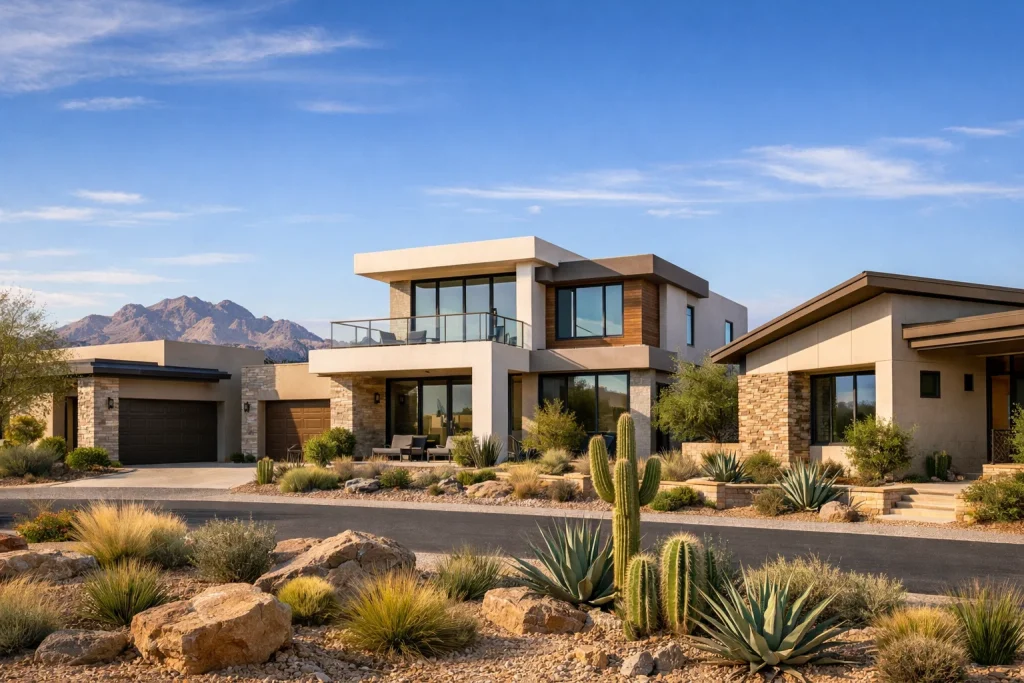
The Phoenix rental market will undergo significant transformation by 2026, reflecting broader changes in housing preferences, demographics, and investment patterns. While homeownership remains a priority for many residents, the rental sector will continue as a vital component of the Phoenix housing market, serving both transitional and lifestyle renters.
Rent growth is projected to moderate to 3-4% annually by 2026, down from the double-digit increases seen in 2021-2022 but still outpacing inflation. This moderation reflects increased rental inventory from both apartment construction and single-family rental communities, creating more options for renters across price points.
The most significant shift in the rental market is the changing renter profile. Phoenix is seeing the emergence of “lifestyle renters” – households with incomes sufficient for homeownership who choose to rent for flexibility, amenities, or location benefits. This demographic includes young professionals, empty nesters, and mobile workers who value freedom from maintenance responsibilities.
Geographic patterns show distinct rental market dynamics across Phoenix neighborhoods. Central Phoenix, Tempe, and Scottsdale command premium rents but face increased competition as new luxury developments come online. The East Valley, particularly Chandler and Gilbert, is seeing strong rental demand from families seeking access to top school districts without the commitment of homeownership.
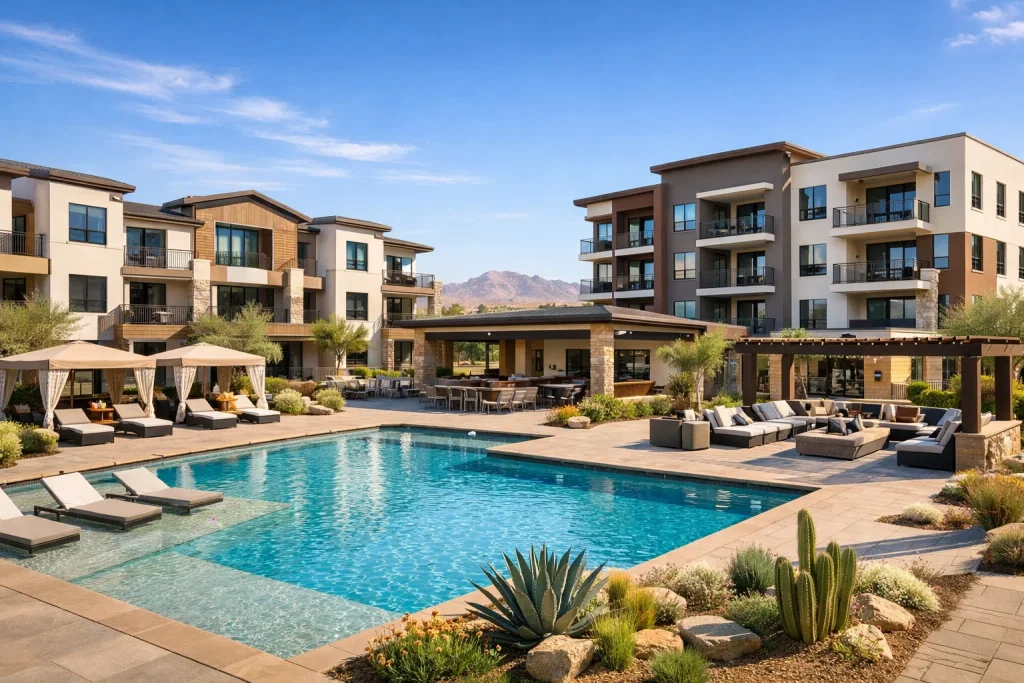
Investors in Phoenix are adapting to these changes by prioritizing property features that appeal to longer-term, higher-income renters. Communities with resort-style amenities, smart home technology, and flexible spaces for remote work are commanding premium rents and experiencing lower turnover rates.
The single-family rental sector, which expanded rapidly in Phoenix during the post-2008 period, continues to evolve with purpose-built rental communities gaining market share. These developments offer the space and privacy of single-family homes with the professional management and amenities of apartment living – a combination increasingly attractive to family renters.
For property owners and investors, this evolving rental landscape requires strategic positioning. Properties with outdated finishes or limited amenities will face increased vacancy risk as renters gain options. Meanwhile, well-located, updated properties with in-demand features will continue attracting qualified tenants even in a more competitive environment.
Family-Focused Rental Demand and “Kidfluence”
By 2026, families with children will represent one of the fastest-growing segments in Phoenix’s rental market, transforming property features, amenity expectations, and neighborhood preferences. This “kidfluence” – the growing impact of child-centric needs on housing decisions – is reshaping how properties are designed, marketed, and managed across Phoenix neighborhoods.
The family rental trend is most pronounced in communities with high-quality school districts, particularly in the East Valley suburbs of Gilbert, Chandler, and parts of Mesa. These areas offer the educational opportunities families prioritize while providing rental options for those not yet ready to purchase in increasingly expensive neighborhoods.
Investors targeting the family rental segment are focusing on specific property characteristics that command premium rents. Three and four-bedroom configurations are in highest demand, while outdoor spaces, proximity to parks, and child-friendly community amenities deliver significant returns on investment.
- Top family-friendly rental amenities driving 2026 demand:
- Private fenced yards or access to community green space
- Extra storage for family equipment and toys
- Flexible spaces that can function as homework areas or play rooms
- Smart home technology for safety and convenience
- Proximity to quality schools (within top district boundaries)
- Community amenities including pools, playgrounds, and walking paths
- Durable, low-maintenance finishes that withstand family use
Property managers report that family renters typically stay 40% longer than non-family tenants, making this demographic particularly valuable for reducing turnover costs and vacancy periods. This stability factor is driving more investors to specifically target family-friendly properties despite the higher initial investment and maintenance costs.
The Phoenix housing market in 2026 will continue to see growth in purpose-built family rental communities – developments specifically designed to serve this demographic with appropriate floor plans, amenities, and management practices. These communities bridge the gap between traditional apartments and single-family homeownership, providing transitional housing for families saving for down payments or those new to the area.

Buyer’s Perspective: Opportunities in the 2026 Phoenix Market
The Phoenix housing market in 2026 presents a markedly improved landscape for buyers compared to the challenging conditions of the early 2020s. Several key market shifts will create opportunities that haven’t existed in years, particularly for buyers who enter the market strategically prepared.
First, buyers in Phoenix will benefit from improved negotiating leverage as housing inventory reaches healthier levels. The ability to include contingencies, request repairs, and negotiate price – all severely limited during the seller’s market – will return to the transaction process. This shift doesn’t signal a buyer’s market, but rather a more balanced environment where reasonable requests are again part of the negotiation.
Second, mortgage rate improvements projected through 2026 will enhance affordability despite home prices remaining well above pre-pandemic levels. Analysts project rates could stabilize in the 5-5.5% range by 2026, significantly improving monthly payment affordability compared to the 7%+ rates seen in 2023.
Third, the increase in housing inventory will provide buyers with more options across different price points and neighborhoods, reducing the pressure to make rushed decisions that characterized the market in recent years.
- Steps for buyers to prepare for the 2026 Phoenix market:
- Secure financing pre-approval to understand exact budget parameters
- Research target neighborhoods thoroughly, including future development plans
- Consider emerging areas with price appreciation potential
- Build relationship with a knowledgeable local agent familiar with specific submarkets
- Be prepared to move quickly on well-priced properties despite the more balanced market
First-Time Homebuyers: Navigating the 2026 Phoenix Market
First-time homebuyers will find the 2026 Phoenix market more accessible than in recent years, though still challenging compared to historical norms. The combination of stabilizing prices, improved inventory, and potentially lower mortgage rates creates a more favorable entry point for those looking to transition from renting to owning.
The primary advantage for first-time buyers in 2026 will be reduced competition. The frenzied multiple-offer scenarios that frequently priced out first-time buyers between 2020-2023 will be less common, creating space for those with FHA loans, down payment assistance, or other first-time buyer financing options to successfully compete for properties.
Entry-level housing inventory is expected to improve significantly by 2026, particularly in areas like Avondale, parts of Mesa, Buckeye, and developing Pinal County communities. These areas offer newer homes at more accessible price points than closer-in Phoenix neighborhoods, with the trade-off of longer commute times to major employment centers.
- First-time homebuyer programs and incentives likely available in 2026:
- Arizona Industrial Development Authority (AzIDA) mortgage programs with down payment assistance
- Phoenix Neighborhood Stabilization Program for specific revitalization areas
- FHA loans with 3.5% down payment requirements
- VA loans for qualified veterans offering zero down payment options
- Community land trust programs in select Phoenix neighborhoods
- Employer-assisted housing programs from major Phoenix employers
The median starter home price in Phoenix is projected to be approximately $350,000-$375,000 by 2026, requiring income levels of roughly $80,000-$90,000 for comfortable affordability (assuming improved mortgage rates). While this remains challenging for many first-time buyers, it represents a more attainable target than during the market peak.
First-time buyers should focus on building credit scores above 700 to secure optimal financing and consider creative paths to homeownership, including townhomes, condos, or properties with rental potential to offset mortgage costs.
Seller’s Advantage: Maximizing Your Property Value in 2026
Sellers entering the Phoenix housing market in 2026 will face a more balanced environment that requires strategic preparation and realistic expectations. While the extreme seller’s advantage of 2021-2022 has moderated, well-positioned properties will continue to attract qualified buyers and command fair market values.
The most significant change for sellers is the expanded housing inventory giving buyers more options. Properties will typically remain on the market longer, with average days-to-contract extending to 60-75 days by 2026, compared to the 10-15 day averages seen during the market peak. This extended timeline means sellers should prepare for longer carrying costs and a more methodical sales process.
Pricing strategy becomes increasingly critical in this environment. Sellers who price based on 2022’s heated market conditions rather than current comparables will see their homes sit while properly priced alternatives sell. Working with agents who understand specific neighborhood dynamics will be essential for determining optimal listing prices.
- High-ROI improvements sellers should consider before listing in 2026:
- Energy efficiency upgrades (HVAC, insulation, windows) – critical in Phoenix climate
- Drought-tolerant landscaping with functional outdoor living spaces
- Kitchen refreshes focused on modern, energy-efficient appliances
- Smart home technology integration (thermostats, security, lighting)
- Interior paint in neutral, contemporary colors
- Updated bathroom fixtures with water-saving features
- Proper preparation for inspection items (roof, electrical, plumbing)
Sellers should also recognize that buyers in 2026 will have increased negotiating leverage. Inspection items that sellers previously could refuse to address will again become negotiation points. Building reasonable repair allowances into pricing strategies will help prevent deals from falling apart during the inspection period.
The timing of selling becomes more strategic in this balanced market. Spring and fall will remain the optimal seasons for marketing Phoenix properties, aligning with weather patterns and buyer activity cycles. Sellers will need to factor these seasonal patterns into their planning, as selling during summer months may require price adjustments to attract buyers.

Investment Hotspots: High-Growth Areas in Phoenix for 2026
For investors looking at the Phoenix housing market in 2026, the opportunity landscape is shifting from broad market appreciation to targeted growth areas with specific value drivers. The era of “buy anywhere in Phoenix and watch it appreciate” has given way to a more nuanced environment requiring strategic property selection and longer investment horizons.
Successful investors in Phoenix are increasingly focused on identifying neighborhoods in various stages of the growth cycle, with particular attention to infrastructure improvements, commercial development, and employment centers that drive housing demand. The most promising investment returns will come from areas experiencing fundamental changes rather than from general market momentum.
Long-term appreciation prospects remain strong in Phoenix compared to many other metropolitan areas, supported by ongoing population growth, land constraints, and the region’s economic development. However, investors should calibrate their expectations for more moderate appreciation rates of 4-6% annually rather than the double-digit gains seen in recent years.
Rental yields will play an increasingly important role in investment returns as price appreciation moderates. Properties that can deliver cash flow while building equity will outperform those dependent primarily on appreciation for returns.
| Investment Area | Projected Appreciation (2024-2026) | Rental Yield | Development Activity |
|---|---|---|---|
| Downtown Phoenix/Midtown | 6-8% | 4.5-5.5% | High – Mixed Use |
| South Scottsdale | 7-9% | 4-5% | Moderate – Redevelopment |
| Mesa – Eastmark Area | 8-10% | 5-6% | High – Residential/Commercial |
| Glendale – Stadium District | 7-9% | 5.5-6.5% | Moderate – Entertainment/Mixed |
| Queen Creek | 9-11% | 5-6% | Very High – Residential |
| Buckeye – Verrado Area | 8-10% | 5.5-6.5% | High – Master Planned |
| Deer Valley/North Phoenix | 7-9% | 5-6% | Moderate – Commercial/Residential |
| Pinal County Corridor | 10-12% | 6-7% | High – Infrastructure/Residential |
Specific Phoenix Metropolitan Area Development Zones
The Phoenix metro area’s vastness creates distinct investment microclimates across neighborhoods, with development activity concentrated in specific growth corridors. Understanding these zones and their unique drivers is crucial for investors targeting the Phoenix housing market in 2026.
Midtown Phoenix is experiencing significant redevelopment as older commercial properties are converted to mixed-use developments with residential components. The extension of light rail along Central Avenue has catalyzed projects like the Central Station redevelopment, creating urban living opportunities with strong rental demand from professionals working downtown or in the central corridor medical campuses.
The Glendale Sports and Entertainment District surrounding State Farm Stadium and Desert Diamond Arena continues to evolve with the VAI Resort development and expanded retail offerings. Residential properties in proximity to this area benefit from both rental demand and appreciation potential as the district matures into a year-round destination.
Mesa’s Eastmark area and surrounding East Valley corridor has emerged as one of the region’s strongest growth zones, supported by the expansion of Phoenix-Mesa Gateway Airport and major employers like Apple’s data center. The announcement of Meta’s $800 million data center project further reinforces the area’s economic development momentum.
In Pinal County, the corridor between Queen Creek and Florence represents the frontier of Phoenix metro expansion, with large master-planned communities like Merrill Ranch offering affordability that attracts both homeowners and investors. The planned North-South Corridor freeway will significantly enhance connectivity to this area, though water availability remains a constraining factor.
The West Valley continues its robust expansion along transportation corridors, with Buckeye’s Verrado community demonstrating how master-planned development can create premium pricing in previously overlooked areas. New industrial development along the Loop 303 corridor is bringing additional jobs to support housing demand in Surprise, Goodyear, and northern Buckeye.
North Phoenix and the Deer Valley area benefit from proximity to major employment centers, with residential development filling in remaining land parcels. The Taiwan Semiconductor Manufacturing Company (TSMC) facility under construction will bring thousands of jobs to this area, creating housing demand across multiple price points.
Investors targeting these development zones should note that each area has distinct buyer and renter profiles, requiring tailored strategies for property types, amenities, and management approaches. Understanding the specific growth drivers and demographic patterns of each zone is essential for optimizing investment returns in the 2026 Phoenix market.
Energy-Efficient and Inflation-Savvy Home Features
By 2026, energy efficiency will transition from a nice-to-have feature to a market necessity in Phoenix, where extreme heat drives utility costs and influences buyer decisions. Properties with thoughtful efficiency features will command premium pricing and experience shorter market times, creating compelling returns for sellers and investors who make strategic improvements.
For sellers in Phoenix, investing in energy-efficient upgrades before listing will increasingly pay dividends in both sale price and market appeal. As utility costs continue rising faster than inflation, buyers are carefully calculating the ongoing operational expenses of potential homes alongside the purchase price.
Buyers in Phoenix are showing greater sophistication in evaluating a home’s efficiency profile, with growing awareness of HVAC SEER ratings, insulation values, and window performance. This education is driven partly by the harsh reality of summer cooling bills that can exceed $400 monthly for inefficient properties.
- Top energy-efficient and inflation-resistant home features adding value in 2026:
- High-efficiency HVAC systems (minimum SEER 16) properly sized for the home
- Comprehensive insulation packages including attic radiant barriers
- Solar panels with battery storage systems
- Low-E, dual-pane windows with proper solar orientation
- Smart home systems that optimize energy usage patterns
- Desert-adapted landscaping that reduces water consumption
- Shade structures that protect windows from direct summer sun
- Energy-efficient appliances, particularly refrigerators and water heaters
- Ceiling fans in all living spaces to reduce air conditioning needs
The return on investment for energy improvements varies by neighborhood and price point, but properties with comprehensive efficiency packages typically sell for 4-7% more than comparable inefficient homes while selling 30% faster. This premium reflects both the immediate appeal of lower utility bills and growing awareness of climate resilience.
For the Phoenix housing market in 2026, these features won’t just add value – they’ll increasingly become expected standards in mid-to-upper price points, with properties lacking basic efficiency measures facing significant market penalties in both price and days-on-market.
Mortgage Rate Projections and Their Impact on Phoenix Housing
Mortgage rates will play a decisive role in shaping the Phoenix housing market in 2026, with current projections suggesting a moderating trend that could significantly boost affordability and transaction volume. After the volatility of recent years, the rate environment is expected to stabilize in a range that balances economic growth with sustainable housing demand.
Economic indicators point to mortgage rates settling in the 5-5.5% range by 2026 – still above the historic lows of 2020-2021 but well below the 7%+ peaks that suppressed market activity in 2023. This moderation reflects Federal Reserve policy normalization as inflation pressures ease and economic growth finds a sustainable pattern.
For the Phoenix housing market specifically, each percentage point decrease in mortgage rates expands the pool of qualified buyers substantially. The impact is most pronounced in middle-market price points ($350,000-$550,000) that represent the bulk of Phoenix housing stock.
The practical effect of falling rates on buyer affordability is significant. A $450,000 home with 20% down payment at 7% interest requires monthly principal and interest payments of approximately $2,395. The same home at 5.25% requires payments of about $1,990 – a monthly savings of $405 that dramatically improves qualification ratios.
This payment differential explains why Phoenix housing market activity will likely accelerate as rates moderate. Many buyers who were priced out by the combined impact of higher home prices and elevated interest rates will return to the market as the affordability equation improves.
For buyers in Phoenix, this rate environment creates strategic timing considerations. Those who enter the market while rates remain elevated may benefit from reduced competition and better negotiating leverage, with the potential to refinance later if rates continue to decrease. Conversely, waiting for lower rates risks competing with the larger buyer pool that lower rates will activate.
Phoenix vs. Other Markets: Comparative Analysis for 2026
The Phoenix housing market in 2026 will maintain distinct advantages compared to other major metropolitan areas, though its value proposition has evolved from the pandemic era. A comparative analysis reveals Phoenix’s competitive position among peer markets nationwide, with implications for both local and relocating buyers.
Affordability remains Phoenix’s primary advantage despite the significant price appreciation of recent years. The median home price-to-income ratio in Phoenix (approximately 5:1 by 2026) will remain below coastal markets like Los Angeles (9:1), San Francisco (10:1), and Seattle (7:1), creating a value proposition for households seeking improved housing for their budget.
Economic indicators show Phoenix maintaining stronger job growth than the national average, with employment diversification reducing the market’s historical boom-bust volatility. The expansion of technology, manufacturing, and healthcare sectors creates a more resilient economic foundation than in previous cycles.
- Phoenix’s competitive advantages vs. other major markets for 2026:
- Lower property taxes than Texas markets (Dallas, Austin, Houston)
- Lower housing costs than West Coast and Northeast metropolitan areas
- Stronger appreciation potential than Midwest markets with slower growth
- No state income tax on retirement income (attracting retiree buyers)
- Year-round outdoor living potential despite summer heat challenges
- Strong rental demand supporting investment properties
- Potential disadvantages:
- Water sustainability concerns affecting long-term growth
- Summer climate extremes intensifying with climate change
- Higher insurance costs due to wildfire and heat risks
- Transportation infrastructure lagging population growth
For relocating buyers, Phoenix will continue attracting those seeking housing value without sacrificing economic opportunity. However, the migration patterns show increasing selectivity, with newcomers targeting specific Phoenix neighborhoods rather than viewing the entire market as equally desirable.
Within Arizona, the Phoenix market will maintain its dominance in both volume and option diversity, though Tucson and smaller markets like Prescott and Flagstaff will attract buyers seeking different lifestyle attributes with similar economic advantages.
Expert Recommendations: Strategic Advice for 2026
The Phoenix housing market in 2026 will reward strategic decision-making based on thoughtful market analysis rather than emotional reactions or outdated assumptions. Different stakeholders – buyers, sellers, and investors – each face unique opportunities and challenges requiring tailored approaches.
For buyers in Phoenix, the 2026 market offers improved conditions worth capitalizing on with proper preparation. The increased housing inventory and reduced competition create space for more deliberate decision-making without the frenzy of multiple offer situations. However, desirable properties in prime locations will still attract significant interest.
Strategic buyers should secure financing pre-approval well before starting their search, understanding that credit standards will likely remain stringent even as rates moderate. Working with agents who have hyperlocal knowledge of specific Phoenix neighborhoods becomes increasingly valuable as market conditions vary significantly across submarkets.
For sellers in Phoenix, the 2026 market requires resetting expectations and emphasizing property presentation. The days of minimal preparation and automatic over-asking offers will have passed, replaced by a more traditional selling environment where condition, pricing, and marketing significantly impact results.
Sellers should invest in pre-listing inspections to identify and address potential issues before they become negotiating points. Professional photography, virtual tours, and targeted digital marketing will separate successful listings from those that linger on the market. Most importantly, sellers must price according to current market conditions rather than peak values or emotional attachments.
For investors in Phoenix, the 2026 market favors specialized knowledge and longer horizons. The easy appreciation of 2020-2022 has been replaced by a market where returns come from identifying specific growth drivers and managing properties efficiently. Investors should focus on cash flow fundamentals rather than speculative appreciation, with particular attention to properties that meet evolving renter preferences.
- Top 5 Recommendations for the 2026 Phoenix Market:
- Look beyond broad market trends to neighborhood-specific conditions, as performance varies dramatically across Phoenix submarkets
- Prioritize properties with energy efficiency features that mitigate rising utility costs in Phoenix’s extreme climate
- Consider transportation access and commute times as critical factors, with traffic congestion increasing across the metro area
- Evaluate water infrastructure and sustainability when investing in outlying development areas
- Balance short-term market conditions with Phoenix’s strong long-term growth fundamentals when making buying, selling, or holding decisions
Conclusion: Positioning Yourself for Success in the 2026 Phoenix Market
The Phoenix housing market of 2026 represents an evolution toward balance after years of extreme conditions. The pendulum that swung dramatically toward sellers in 2021-2022 will find middle ground, creating a healthier environment that can better serve the needs of all participants.
For buyers in Phoenix, the 2026 market offers improved affordability through the combined effect of price stabilization, increased inventory, and moderating mortgage rates. Those who enter the market with clear financial parameters, neighborhood knowledge, and reasonable expectations will find opportunities that simply didn’t exist during the frenzied seller’s market. First-time buyers in particular will benefit from reduced investor competition and more accessible financing options.
For sellers in Phoenix, the market remains fundamentally sound despite the shift from extreme seller advantage. Well-maintained, properly priced homes will continue to sell, though typically with longer marketing periods and more balanced negotiations. Sellers who adapt to these conditions rather than expecting 2021-era results will successfully transition to their next property.
The Phoenix metropolitan area’s underlying growth drivers – job creation, migration patterns, and relative affordability compared to coastal markets – remain intact, supporting long-term housing demand across price points. While the double-digit annual appreciation of recent years won’t continue, the market’s fundamentals support stable, sustainable growth that benefits long-term residents and newcomers alike.
Ultimately, success in the 2026 Phoenix housing market will come from seeing it clearly for what it is – neither boom nor bust, but rather a functioning market that balances opportunity and challenge for all participants.
FAQ: Phoenix Housing Market 2026
- What is the projected median home price in Phoenix for 2026?
The Phoenix median home price is projected to reach approximately $470,000-$490,000 by 2026, representing moderate annual appreciation of 2-4%. This reflects a normalization from the extreme growth rates of 2021-2022 while acknowledging Phoenix’s continuing population growth and housing demand. - Will Phoenix be a buyer’s or seller’s market in 2026?
Phoenix is trending toward a balanced market by 2026, with 3-4 months of housing inventory expected. This represents a significant shift from the extreme seller’s market of 2021-2022, giving buyers more options and negotiating room while still allowing properly priced homes to sell within reasonable timeframes. - What major developments will impact Phoenix’s housing market by 2026?
Key developments include the Taiwan Semiconductor Manufacturing Company (TSMC) facility in North Phoenix, the VAI Resort in Glendale, continued expansion around Phoenix-Mesa Gateway Airport, and the North-South Corridor freeway in Pinal County. These projects are creating housing demand in surrounding areas. - Will mortgage rates go down by 2026?
Mortgage rates are projected to moderate to approximately 5-5.5% by 2026, down from the 7%+ peaks seen in 2023. This reduction significantly improves affordability for Phoenix buyers, though rates will likely remain above the historic lows of 2020-2021. - Should I wait until 2026 to sell my house in Phoenix?
Timing depends on personal circumstances rather than trying to perfectly time the market. By 2026, sellers will face more balanced conditions with longer marketing periods but stable prices. Those needing maximum value might consider selling sooner, while those prioritizing easier purchasing conditions might benefit from waiting. - How will housing inventory levels in Phoenix change by 2026?
Phoenix housing inventory is expected to reach 3-4 months of supply by 2026, approaching balanced market conditions. This represents a significant increase from the extreme shortages of 2021-2023, driven by new construction, slower population growth, and normalized buying patterns. - What impact will falling mortgage rates have specifically on Phoenix’s housing market in 2026?
Falling mortgage rates will expand the buyer pool in Phoenix, particularly for middle-market homes ($350,000-$550,000). Each 1% decrease in rates improves purchasing power by roughly 10%, bringing previously sidelined buyers back into the market while improving qualification ratios for first-time buyers. - Will Phoenix be among the markets where buyers get a break in 2026?
Yes, Phoenix buyers will see improved conditions by 2026 compared to recent years. Increased inventory, moderating prices, and potentially lower interest rates combine to create more buyer-friendly conditions, though Phoenix will remain more competitive than many Midwest and Southern markets. - What should buyers, sellers, and investors in Phoenix expect in 2026?
Buyers can expect more options and negotiating power. Sellers should prepare for longer marketing periods but stable prices with proper presentation. Investors should focus on specific growth areas rather than market-wide appreciation, with emphasis on cash flow fundamentals and targeted property improvements. - How will Phoenix’s population growth affect housing demand in 2026?
Phoenix’s population is projected to grow by approximately 85,000 people annually through 2026, creating sustained housing demand across segments. While this growth rate has moderated from pandemic peaks, it remains well above the national average, supporting long-term housing needs. - Are housing prices expected to go down in Phoenix in 2026?
A broad price decline is unlikely by 2026, but appreciation will moderate to 2-4% annually – a sustainable pace aligned with income growth. Individual neighborhoods may see varying performance, with some stabilizing while others with specific growth drivers continue stronger appreciation. - Is 2026 a good time to buy a rental property in Phoenix?
2026 offers more balanced conditions for rental property investment in Phoenix, with cash flow fundamentals improving as price-to-rent ratios normalize. Investors should target specific growth corridors rather than expecting market-wide appreciation, with focus on properties offering both rental yield and modest appreciation potential. - What challenges do first-time buyers face in the Phoenix market in 2026?
First-time buyers in 2026 will still face affordability challenges with median starter homes around $350,000-$375,000, requiring incomes of $80,000-$90,000 for comfortable qualification. However, improved inventory and potentially lower rates will create better conditions than the 2021-2023 market. - Which Phoenix neighborhoods are expected to see the highest appreciation by 2026?
The highest appreciation potential exists in Queen Creek, the Pinal County corridor, Mesa’s Eastmark area, and parts of the West Valley along the Loop 303. These areas benefit from infrastructure improvements, job creation, and relative affordability compared to established core neighborhoods. - How will Phoenix’s housing affordability compare to other major cities in 2026?
Phoenix will maintain its affordability advantage compared to coastal markets like Los Angeles, San Francisco, Seattle, and New York, with home price-to-income ratios approximately 40-60% lower. However, the gap has narrowed from historical levels as Phoenix prices have risen faster than many markets in recent years.