

Phoenix gets just 8 inches of annual rainfall while summer temperatures routinely exceed 110°F, creating extreme challenges for traditional landscaping. Desert landscaping offers Phoenix homeowners a practical solution by working with our climate rather than against it. By incorporating native plants, efficient irrigation, and strategic design, desert landscaping dramatically reduces water consumption while creating stunning outdoor spaces that reflect the natural beauty of the Sonoran Desert.
Why Desert Landscaping Makes Sense for Phoenix Homeowners
Phoenix’s harsh desert climate demands thoughtful landscaping approaches. With water restrictions tightening and temperatures rising, desert landscaping has evolved from an environmental choice to a practical necessity for Valley homeowners. Traditional grass lawns in Phoenix can consume up to 80% more water than native landscapes, making desert landscaping financially prudent.
The economics are compelling: converting a 1,000-square-foot lawn to desert landscaping can save 55,000 gallons of water annually in Phoenix. Beyond immediate water bill reductions, desert landscapes typically require 60-75% less maintenance than traditional yards, eliminating the need for constant mowing, fertilizing, and reseeding.
Phoenix properties with desert landscaping often command 7-15% higher resale values, according to local real estate analyses. Buyers increasingly recognize the value proposition: lower maintenance costs, reduced water bills, and environmental responsibility packaged in an authentic Southwest aesthetic.
- Reduced water consumption (50-80% less than traditional lawns)
- Lower maintenance requirements and costs
- Increased property value and curb appeal
- Better adaptation to Phoenix’s climate extremes
- Enhanced environmental benefits for local ecosystems
- Resistance to drought conditions
- Reduced carbon footprint from elimination of gas-powered equipment
Beyond Water Savings: The Hidden Benefits of Desert Landscaping
While water conservation remains the primary motivation for desert landscaping, the ecological benefits extend much further. Native plants like penstemon, brittlebush, and desert marigold create critical habitat corridors for pollinators throughout urban Phoenix. A single mature desert willow can support dozens of native bird species and countless beneficial insects.
Research from Arizona State University shows that properly designed native plant landscapes reduce ambient temperatures by 5-8°F compared to rock-only xeriscapes. This cooling effect contributes to energy savings by reducing air conditioning demands during summer months. Additionally, native plant roots help manage stormwater runoff, reducing erosion and flooding risks during monsoon season.
Native landscapes also reconnect homeowners with the unique Sonoran Desert ecosystem, promoting a sense of place and regional identity that’s impossible to achieve with generic, water-intensive landscapes.
Why Phoenix Is Going Desert-First
Phoenix water usage data reveals a definitive trend: desert landscaping adoption has increased 37% since 2018. This shift reflects both ecological awareness and practical adaptation to our water reality. Phoenix faces extended drought conditions, with Lake Mead and the Colorado River system at historic lows, forcing water managers to implement increasingly stringent conservation measures.
Many Phoenix municipalities now offer rebates up to $3,000 for turf conversion to desert landscaping, while some HOAs have modified CC&Rs to encourage water-efficient designs. Climate projections suggest Phoenix will experience 5-10 more days annually above 110°F by 2030, making drought-tolerant landscapes not just environmentally responsible but essential for practical livability.
As Phoenix continues growing, desert landscaping represents smart adaptation to our environment rather than fighting against it.
Essential Elements of Successful Desert Landscape Design
Effective desert landscape design balances aesthetics, functionality, and resource efficiency through thoughtful planning. Unlike traditional landscapes that often begin with a lawn as the default canvas, desert landscaping requires strategic consideration of space, circulation patterns, and plant communities.
The best desert landscapes incorporate layers – from groundcovers and perennials to shrubs and trees – creating visual interest while maximizing cooling effects. Proper spacing is critical, allowing enough room for mature plant growth while creating appropriate density for both appearance and temperature moderation.
Hardscape elements like boulders, decorative gravel, and pavers provide structure and visual interest during dormant seasons or before plants reach maturity. The most successful designs incorporate 60-70% living material (plants) with 30-40% hardscape elements, creating balance that evolves beautifully as the landscape matures.
Water management shapes every aspect of desert landscape design, from slight grade modifications that capture rainfall to strategic plant groupings based on water needs (hydrozoning). Well-designed spaces also consider seasonal changes – providing shade during summer while allowing warming sunlight during winter months.

Native Plants That Thrive in Phoenix’s Climate
Selecting appropriate plants for Phoenix’s climate means understanding not just drought tolerance but heat resistance, cold hardiness for occasional freezes, and adaptation to alkaline soils. Native plants that evolved in the Sonoran Desert naturally possess these adaptations.
| Plant Name | Water Needs | Sun Requirements | Mature Size | Special Features |
|---|---|---|---|---|
| Saguaro Cactus | Very Low | Full Sun | 40-60′ tall | Iconic Arizona symbol, extremely slow-growing |
| Desert Ironwood | Low | Full Sun | 25′ tall x 25′ wide | Beautiful bark, purple flowers, dense shade |
| Mesquite | Low | Full Sun | 30′ tall x 30′ wide | Fast growth, filtered shade, wildlife value |
| Barrel Cactus | Very Low | Full/Part Sun | 3-4′ tall x 2′ wide | Yellow/orange flowers, striking form |
| Ocotillo (Fouquieria splendens) | Very Low | Full Sun | 15-20′ tall x 10′ wide | Red flower tips, unique architectural form |
| Brittlebush | Low | Full Sun | 3′ tall x 3′ wide | Silver foliage, yellow flowers, fast-growing |
| Desert Marigold | Low | Full Sun | 2′ tall x 2′ wide | Bright yellow flowers, reseeds readily |
| Palo Verde | Low | Full Sun | 20-30′ tall x 20-30′ wide | Green bark, yellow spring flowers, light shade |
The saguaro cactus, while iconic, grows extremely slowly (1-1.5 inches yearly) and requires special permits for transplanting. For immediate impact, consider faster-growing natives like brittlebush, desert ironwood, or palo verde trees. Barrel cactus provides bold structure with minimal space requirements, while ocotillo (Fouquieria splendens) offers dramatic vertical elements with brilliant red spring flowers.
Most native plants require regular water during establishment (6-12 months) before becoming drought-tolerant. Group plants with similar water requirements to prevent over or under-watering different species.

Creating Functional Outdoor Living Spaces in Desert Environments
Phoenix’s climate presents unique challenges for outdoor living spaces, with summer temperatures limiting usage of poorly designed areas. Effective desert outdoor spaces prioritize shade creation through built structures and strategic tree placement.
Design orientation matters significantly – eastern exposures allow morning activity before afternoon heat, while western-facing areas become practically unusable in summer without substantial shade. Hardscape material selection dramatically impacts comfort; light-colored, high-SRI (solar reflectance index) materials like cool deck or porcelain pavers can measure 30-40°F cooler than dark pavers or concrete.
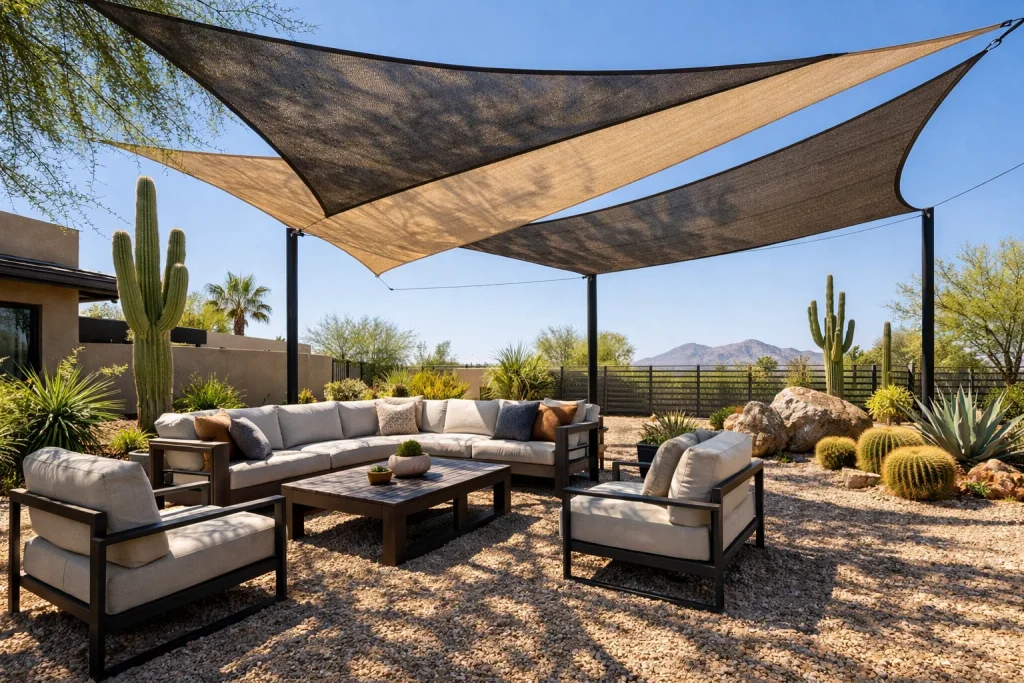
Overhead structures should block sun while allowing heat to escape. Traditional solid patio covers trap heat, while options like shade sails, pergolas with adjustable louvers, or widely spaced wood slats provide better airflow. Consider prevailing wind patterns to capture cooling breezes through deliberate structure orientation.
- Use shade trees on east/west exposures (palo verde, mesquite, desert willow)
- Install shade sails or pergolas with at least 50% coverage
- Create cooling microclimates with plant groupings near seating areas
- Select light-colored, reflective hardscape materials
- Position water features where prevailing winds carry evaporative cooling
Add Texture with Ornamental Grasses
Ornamental grasses provide essential texture, movement, and seasonal interest in desert landscapes that hardscapes and cacti alone cannot deliver. Pink muhly grass creates spectacular sunset-colored plumes in fall, while deer grass forms elegant rounded mounds reaching 3-4 feet tall with golden seedheads.
These grasses require 30-50% less water than traditional turf while providing habitat for small birds and beneficial insects. They also soften harsh landscape lines and transitions between hardscape elements. For tight spaces, try blue grama grass, which stays compact at 12-18 inches tall while offering similar movement benefits.
Plant grasses where they’ll catch morning or evening light for dramatic backlighting effects. Most ornamental grasses need annual cutting back in late winter before new growth emerges.

Low‑Water Desert Landscaping Ideas in Phoenix
Creating a thriving low‑water landscape in Phoenix doesn’t mean sacrificing beauty or functionality. The key is selecting plants specifically adapted to our climate and designing hydrozones that group plants with similar water requirements together. This approach allows you to create lush garden areas near your patio or entry while maintaining truly drought‑tolerant zones requiring minimal irrigation in remote corners of your property.
Start with a clear water strategy: determine which areas deserve regular attention (near seating areas, visible from windows) versus transitional zones that bridge between your home and the wild desert beyond. By thoughtfully planning water zones, you transform a bare yard into a genuinely low‑water landscape that feels designed rather than simply maintained.
Best Native Plants for Shade in Phoenix Yards
Shade is perhaps the most valuable commodity in Phoenix landscaping, and native trees deliver both water efficiency and the cooling effect essential for summer usability. When selecting shade plants, consider which will thrive specifically in Phoenix’s unique microclimate while providing the depth and character that make yards feel like outdoor rooms rather than sparse desert expanses.
Top Native Shade Plants for Phoenix:
| Plant Name | Water Needs | Growth Rate | Mature Height | Special Features |
|---|---|---|---|---|
| Desert Willow (Chilopsis linearis) | Low-Moderate | Fast (3-4 ft/year) | 20-30′ tall × 15-20′ wide | Purple-pink flowers, filtered shade, wildlife magnet, deciduous for winter sun |
| Mesquite (Prosopis velutina) | Very Low | Fast (3-5 ft/year) | 30′ tall × 30′ wide | Deep roots, minimal water once established, delicate filtered shade, beans feed wildlife |
| Palo Verde (Cercidium floridum) | Very Low | Moderate (2-3 ft/year) | 20-30′ tall × 20-30′ wide | Green bark, stunning spring flowers, light dappled shade, early leaf drop in drought |
| Desert Ironwood (Olneya tesota) | Very Low | Slow (1-2 ft/year) | 25′ tall × 25′ wide | Dense evergreen shade, beautiful purple flowers, long-lived, premium durability |
| Canyon Hackberry (Celtis pallida) | Low | Moderate | 20-30′ tall × 20-30′ wide | Birds love the fruit, small leaves create dappled shade, cold-hardy for occasional freezes |
| Acacia (Acacia gregii – Catclaw) | Very Low | Moderate | 15-25′ tall × 15-20′ wide | Stunning yellow flowers, excellent for wildlife, interesting spreading form |
| Desert Ash (Fraxinus velutina) | Low-Moderate | Fast | 40-50′ tall × 40′ wide | Deciduous, provides excellent summer shade, vibrant fall color, native to washes |
| Texas Privet (Forestiera pubescens) | Very Low | Moderate | 12-20′ tall × 12-20′ wide | Excellent screening tree, small delicate leaves, bird-friendly fruit, native to Arizona |
Each of these species brings distinct advantages. If you want the fastest shade establishment, desert willow and mesquite deliver impact in just 3-5 years. For permanent, dense evergreen shade that works year‑round, desert ironwood justifies its slower growth rate. Canyon hackberry and Texas privet excel in tighter spaces while supporting local wildlife communities.
Pro Tip: Plant shade trees on eastern and western exposures where intense afternoon sun creates heat stress. This positioning allows summer shade while permitting winter sun penetration when you want passive heating and lower temperatures don’t require shade.
How to Design a Low‑Water Yard in Phoenix
Designing an effective low‑water Phoenix yard requires thinking in zones and layers rather than treating the entire space as a single landscape. This systematic approach prevents the common mistake of watering drought‑adapted plants in remote areas while underwatering thirsty plants near your home.
The Three‑Zone Approach:
- Active Living Zone (highest water investment, closest to house)
- Include shade trees, colorful accent plants, comfortable seating areas
- 20-30% of total yard space
- Plants like desert willow, lantana, desert rose, palo verde
- Moderate to regular watering (drip irrigation 2-3 times weekly in summer)
- Examples: shaded patios, dining areas, entry courtyards
- Transitional Zone (moderate water use, middle distances)
- Bridge between active living and native desert
- 40-50% of total yard space
- Mix of drought‑adapted plants, structural elements, pathways
- Plants like brittlebush, desert marigold, palo verde, smaller cacti
- Minimal watering (drip irrigation 1-2 times weekly in summer after establishment)
- Examples: garden beds, walkways, screening elements
- Native Desert Zone (minimal water after establishment, back/corners)
- True desert conditions with established native plants
- 20-30% of total yard space
- Plants like creosote, barrel cactus, ocotillo, native groundcovers
- Establishment watering only, then essentially rain‑fed
- Examples: corner plantings, buffer zones, natural desert look
Key Design Steps:
- Sketch your yard’s sun exposure patterns (mark areas receiving 6+ hours of sun, part shade, full shade)
- Identify your active living zones based on views from windows and existing use patterns
- Position shade trees to reduce afternoon heat on western exposures
- Design separate irrigation zones for each water level, never mixing high and low water plants on the same line
- Create visual flow using repetition (plant the same species in multiple locations for cohesion)
- Leave 30-40% of planting areas as future expansion room; resist the temptation to plant too densely initially
This three‑zone approach achieves low‑water goals while creating functionally diverse yards that work for actual living rather than simply minimizing maintenance.
Mini‑FAQ: Low‑Water Landscaping
Q: How long does it take for desert plants to become drought‑tolerant?
A: Most native plants require 6-12 months of regular watering during establishment before shifting to minimal irrigation. Even “drought‑tolerant” species need consistent moisture while developing root systems. Once established, however, they require far less water than traditional plants.
Q: Can I design a low‑water yard that still has green plants?
A: Absolutely. Many native desert plants stay green year‑round, and deciduous species like desert willow provide vibrant foliage during growing seasons. Pairing trees for filtered shade actually supports more diverse plant growth than full sun or full shade alone.
Q: Is a low‑water landscape more expensive than traditional landscaping?
A: Initial costs are often similar, but operational savings through reduced water bills and maintenance make low‑water designs more economical over 5-10 years. Many Phoenix water utilities offer rebates up to $3,000 for turf removal, further offsetting initial investment.
Incorporate Cacti and Succulent Groupings
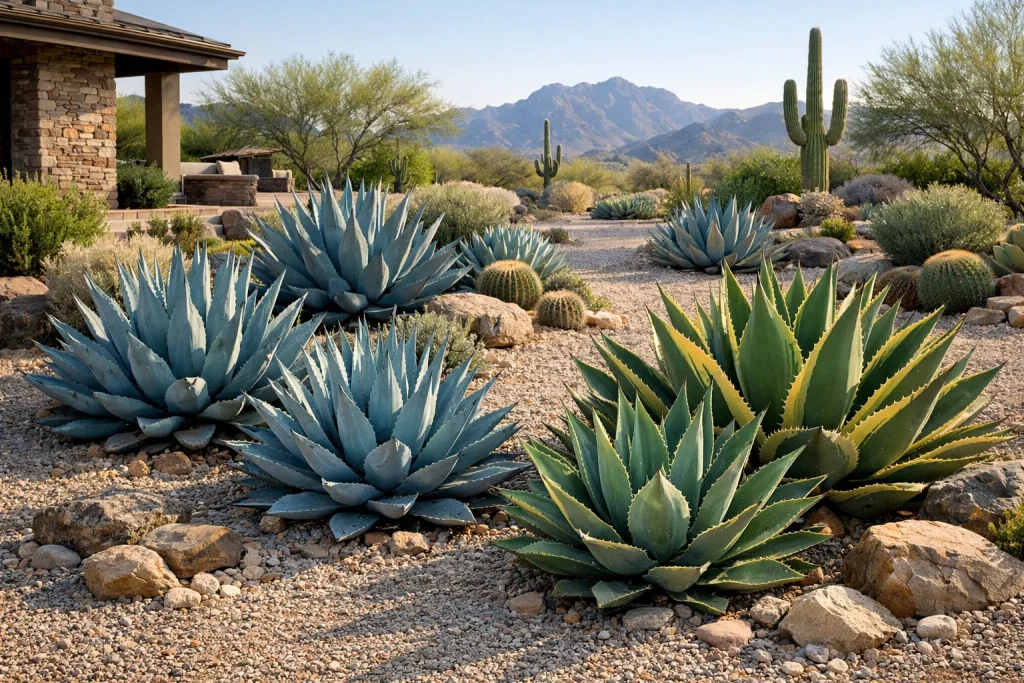
Effective cacti and succulent arrangements follow basic design principles that enhance their natural sculptural qualities. Create visual interest by combining different forms – pair columnar cacti like Mexican fence post with rounded forms like barrel cactus and low-growing groundcovers like ice plant or desert spoon.
Scale relationships matter significantly in desert groupings. Follow the 1:3:5 rule, placing plants at varying heights with adequate spacing for mature growth. For residential settings, limit potentially dangerous species with aggressive spines (cholla, prickly pear) to background positions away from walkways and activity zones.
Barrel cactus makes excellent focal points with their symmetrical form and seasonal yellow-orange flowers. For dramatic effect, group odd numbers (3, 5, or 7) of the same species at different sizes. Ensure all cacti receive appropriate drainage through soil amendments or slight mounding, as root rot from poor drainage kills more cacti than drought.
Implementing Your Desert Landscape: From Planning to Planting
Successful desert landscape implementation requires thoughtful sequencing that differs from traditional landscape installation. Begin with comprehensive site analysis documenting existing conditions: drainage patterns, sun/shade zones, soil composition, and views you want to preserve or screen. Take soil samples to identify potential issues with pH, salinity, or compaction that might affect plant performance.
Create a detailed design plan accounting for mature plant sizes to prevent costly rework later. For larger properties, consider phased implementation focusing first on framework elements like trees, major hardscaping, and irrigation infrastructure, adding understory plants in subsequent seasons.
When transitioning from traditional lawns to desert landscaping, proper grass removal is critical. Simply covering lawn with rock causes anaerobic decomposition and gas buildup. Either physically remove turf and roots or use sheet mulching techniques that allow complete decomposition before installing new plants.
- Site Assessment: Document existing conditions, drainage patterns, and soil characteristics
- Design Development: Create comprehensive plan with planting zones and hardscape elements
- Demolition: Remove existing turf or incompatible elements
- Grading: Establish proper drainage away from structures and create water harvesting features
- Irrigation Installation: Install efficient drip systems with proper zoning before planting
- Hardscape Construction: Build walls, pathways, and structural elements
- Planting: Install trees first, followed by shrubs and groundcovers
The best planting windows in Phoenix are October-November and February-March, avoiding summer heat stress during establishment. Schedule major hardscape work during cooler months for worker comfort and material stability (concrete curing is compromised above 95°F).
Water-Efficient Irrigation Systems for Desert Gardens
Drip irrigation delivers water directly to plant root zones, reducing waste from overspray, runoff, and evaporation common with traditional sprinklers. For Phoenix landscapes, pressure-compensating emitters maintain consistent flow despite elevation changes, while inline emitter tubing works efficiently for plant groupings and groundcovers.
System design should create separate hydrozones grouping plants with similar water requirements. Trees typically need their own dedicated irrigation lines with multiple emitters that can be moved outward as root systems expand. Initial establishment periods require more frequent watering, so irrigation controllers should permit seasonal programming adjustments.
Smart controllers using local weather data or soil moisture sensors significantly improve water efficiency by automatically adjusting run times based on actual conditions. Many Phoenix water utilities offer rebates covering 50-75% of smart controller costs. Proper system maintenance remains essential – monthly emitter checks and seasonal system flushing prevent clogs from Phoenix’s hard, mineral-rich water.
Hardscaping Elements That Complement Desert Plants
Hardscape materials in Phoenix desert landscapes must withstand extreme temperature fluctuations and intense UV exposure. Natural stone like Arizona flagstone and sandstone performs exceptionally well, developing an attractive patina rather than degrading. For manufactured materials, concrete pavers with UV-resistant pigments maintain color integrity while providing design flexibility.
Decomposed granite (DG) serves as the foundational inorganic mulch for most Phoenix desert landscapes, available in colors that complement both architecture and native soils. Select stabilized or resin-bound DG for pathways to prevent erosion and tracking. For accent areas, larger cobbles or river rock create visual interest but should be used sparingly due to heat retention.
- Flagstone: Excellent for patios and pathways, stays cooler than concrete, natural appearance
- Decomposed granite: Primary groundcover, available in earth tones, good for plant health
- Boulders: Create natural focal points, provide habitat niches, Apache and desert buff varieties match native terrain
- Concrete pavers: Durable walking surfaces, wide design selection, permeable options available
- Gabion walls: Permeable rock-filled structures, natural appearance, good for grade changes
- Cor-Ten steel: Modern edging material, develops rust patina that complements desert tones
Proper installation techniques make significant differences in hardscape longevity. Paver bases require adequate depth (4-6 inches of compacted aggregate) to prevent settling, while metal edging should include expansion gaps every 20 feet to accommodate Phoenix’s extreme thermal fluctuations.

Gravel, Decomposed Granite, and Rock Beds
Decomposed granite (DG) forms the foundation of most Phoenix desert landscapes, functioning as both aesthetic groundcover and practical mulch. Installation depth significantly impacts performance – 2-3 inches provides optimal weed suppression while allowing proper water penetration. Thinner applications wash away during monsoon rains, while excessive depth impedes water movement to plant roots.
Compaction level affects both appearance and function. For pathways, compacting DG with water and stabilizer creates firm surfaces, while planting areas benefit from looser application allowing water and root penetration. Proper edging installation prevents migration during heavy rains using metal, concrete, or stone materials extending at least 1 inch below the granite layer.
Color selection impacts both aesthetics and heat reflection. Lighter DG colors like Apache Brown, Madison Gold, or Desert Gold reflect more heat than darker tones like Table Mesa Brown, keeping soil temperatures 15-20°F cooler during summer months, benefiting plant roots and reducing water evaporation.
Mulch That Works with the Desert
Desert landscaping requires appropriate mulch selection balancing water conservation, temperature moderation, and aesthetic considerations. Inorganic mulches like decomposed granite provide long-term durability in Phoenix’s intense sun, while organic mulches offer better soil enhancement but break down rapidly requiring frequent replacement.
| Mulch Type | Water Retention | Heat Reflection | Longevity | Best Applications |
|---|---|---|---|---|
| Decomposed Granite | Moderate | Good (light colors) | 5+ years | Primary groundcover, pathways |
| River Rock | Poor | Poor (high heat retention) | 10+ years | Drainage areas, accents only |
| Shredded Cedar | Excellent | Good | 1-2 years | Planting beds, transitional areas |
| Composted Wood Chips | Very Good | Moderate | 1-2 years | Tree basins, vegetable gardens |
For plant health, organic mulches like wood chips create superior environments, improving soil biology and moisture retention. However, in Phoenix’s heat, these materials decompose within 1-2 years requiring replacement. A hybrid approach often works best – using decomposed granite as the primary groundcover with organic mulch in planting basins, particularly for trees and large shrubs.
Maintaining Your Desert Landscape: Seasonal Care Guide
Contrary to common misconception, desert landscaping is not maintenance-free, though it requires significantly different care than traditional landscapes. Phoenix’s unique climate creates distinct maintenance cycles based around two primary growing seasons – spring (February-May) and fall (September-November) – with reduced plant activity during summer heat and winter cool periods.
Pruning schedules should align with natural growth cycles. Schedule major pruning for woody plants like desert trees and shrubs during winter dormancy (December-January), avoiding pruning during nesting season (April-June). Cacti and succulents typically need minimal pruning beyond removing damaged sections, with work best performed during dry periods to prevent infection at cut surfaces.
Irrigation maintenance becomes critical during Phoenix’s extreme heat. Monthly system checks from May-September should include cleaning filters, checking emitters for clogs (common with mineral-rich Phoenix water), and adjusting watering depth based on seasonal needs. Deep, infrequent watering promotes stronger root systems compared to frequent shallow irrigation.
| Season | Pruning Tasks | Irrigation Adjustments | Plant Care | Pest Management |
|---|---|---|---|---|
| Winter (Dec-Feb) | Major structural pruning for trees and shrubs | Reduce frequency by 30-50% | Plant native trees and shrubs | Monitor for scale insects |
| Spring (Mar-May) | Light pruning, deadhead flowers | Gradually increase as temperatures rise | Apply light organic fertilizer if needed | Watch for aphids on new growth |
| Summer (Jun-Aug) | Minimal – emergency pruning only | Early morning deep watering | Add shade cloth for sensitive plants | Monitor for spider mites |
| Fall (Sep-Nov) | Clean up summer growth, remove seed heads | Gradually reduce as temperatures drop | Plant wildflowers and cool-season plants | Check for agave snout weevils |
Weed management becomes most challenging during monsoon season when summer rains germinate dormant seeds. Apply pre-emergent herbicides in late spring before monsoon season and again in fall to reduce weed pressure, focusing on maintained rock and decomposed granite areas rather than dense plantings where desirable seedling volunteers might be affected.
Keeping Your Arizona Desert Landscape Green All Year Long
Phoenix’s bimodal climate with two distinct growing seasons allows for year-round landscape interest when plants are selected with seasonal appeal in mind. Winter and spring (December-April) feature spectacular wildflower displays from desert marigold, penstemon, and brittlebush, while trees like palo verde and desert ironwood produce dramatic spring flowers.
Summer dormancy affects many native plants as a natural adaptation to extreme heat. Plan for visual interest during this period through structural elements like specimen cacti, boulders, and architectural plants that maintain appearance regardless of growing conditions. Strategic irrigation during early morning hours helps heat-stressed plants survive 110°F+ days without encouraging excessive soft growth susceptible to sun damage.
Phoenix’s occasional winter freezes (temperatures below 32°F) can damage tropical and semi-tropical plants often sold at nurseries. Protect borderline species like bougainvillea and lantana during freeze warnings by covering with breathable fabric, not plastic. For long-term success, select truly cold-hardy native species from higher Sonoran Desert elevations that withstand both summer heat and occasional winter freezes.
Transforming Challenges into Opportunities: Professional Approaches to Desert Landscaping
Professional desert landscape designers view challenging site conditions as opportunities rather than limitations. Sloped properties prone to erosion become showcases for dramatic boulder placement and terraced planting areas that slow water movement. Western exposures with intense afternoon sun transform into striking cactus gardens featuring plants naturally adapted to reflect solar radiation.
One standard approach involves “reading” the existing landscape for cues. Native plant communities naturally arrange themselves based on slight changes in topography, exposure, and soil composition. By identifying these microenvironments within a property, designers can place plants where they’ll naturally thrive rather than fighting site conditions.
Problem soils represent another common challenge. Phoenix’s alkaline, mineral-heavy soils typically require amendment rather than replacement. Professional solutions might include:
Instead of fighting Phoenix’s climate, professional desert landscapers work with it, scheduling installation during optimal seasonal windows (October-November and February-March), protecting new plants during establishment, and selecting materials that patinate gracefully under intense sun rather than degrading. This approach treats the landscape as a long-term investment that appreciates with age rather than a static installation requiring constant maintenance to maintain its initial appearance.

Case Studies: Before and After Desert Landscape Transformations
A 1980s ranch home in North Phoenix replaced 2,800 square feet of struggling Bermuda lawn with a desert landscape focused on native trees and a central gathering space. The transformation reduced water consumption by 73,000 gallons annually (76% reduction) while creating an outdoor living area usable year-round. Mature mesquite and palo verde trees now provide dappled shade, while strategically placed boulders and a small stone water feature create focal points visible from inside the home.
In Gilbert, a new construction home with builder-grade rock front yard received a desert landscape makeover using xeriscaping principles. The design incorporated three distinct hydrozones: a no-irrigation zone using only native plants for the parkway strip, a minimal irrigation zone for the main yard featuring drought-adapted species, and a moderate irrigation zone near the entry with more colorful accent plants. Water usage dropped 60% compared to neighboring properties with similar lot sizes.
A challenging corner lot in Mesa with poor drainage was transformed using a dry creek bed design that captures roof runoff and redirects it to planted basins. The design solved persistent flooding issues while creating visual interest through elevation changes. Gabion basket retaining walls created level planting areas while allowing water to percolate slowly into the soil, supporting a diverse plant palette that would have failed under previous conditions.
Creative Touches That Personalize the Space
Successful desert landscapes balance regional authenticity with personal expression through carefully chosen design elements. Sculptural metal art pieces in rust patinas complement desert tones while creating focal points. Consider custom pieces from local artisans that incorporate regional motifs or abstract nature-inspired forms that enhance rather than compete with the landscape.
Lighting transforms desert landscapes after dark, highlighting plant architecture invisible during daylight. Low-voltage systems with well-placed uplights on specimen plants like ocotillo or saguaro create dramatic nighttime effects while enhancing security. Solar pathway lights eliminate wiring needs for remote garden areas.
Water features designed for minimal consumption add sensory dimensions through sound and movement. Recirculating systems with small reservoirs use significantly less water than traditional fountains while providing the psychological cooling effect of moving water. Position these features where prevailing breezes carry evaporative cooling to seating areas.
Taking the Next Step: Implementing Desert Landscaping for Your Phoenix Home
Implementing desert landscaping involves decisions about approach (professional vs. DIY), budget allocation, and implementation timeline. For most Phoenix homeowners, a hybrid approach proves most effective – engaging professional design services to create a comprehensive plan, then implementing in phases either professionally or as DIY projects based on complexity.
Budget considerations should prioritize infrastructure elements that are difficult or expensive to modify later: drainage solutions, grade changes, major hardscaping, and large specimen trees. These foundational elements typically represent 60-70% of total project costs but create the framework for successful long-term landscape performance.
For larger properties, phased implementation makes desert landscaping more financially manageable while allowing the landscape to establish gradually. A typical phasing approach might include:
- Phase 1: Demolition, grading, drainage corrections, irrigation infrastructure
- Phase 2: Major hardscaping and specimen tree installation
- Phase 3: Secondary planting (shrubs, accents, groundcovers)
- Phase 4: Finishing elements (lighting, furniture, decorative features)
When selecting landscape professionals, look beyond standard landscapers to firms specializing in desert-appropriate design. Request evidence of desert-specific knowledge including plant identification, proper irrigation design, and experience with water harvesting techniques. Review portfolios focusing specifically on desert projects similar to your property’s conditions.

Cost-Effective Landscaping Packages
Desert landscaping in Phoenix ranges from $5-25 per square foot depending on complexity, plant density, and hardscape materials. While initial installation costs typically exceed traditional landscaping, operational savings over time create significant return on investment through reduced water bills and maintenance costs.
| Budget Level | Approximate Cost Range | Typical Elements | Best For |
|---|---|---|---|
| Starter | $5-8 per sq ft | Basic irrigation, decomposed granite, limited plant palette | New construction, investment properties |
| Mid-Range | $10-15 per sq ft | Quality irrigation, accent boulders, diverse native plants | Primary residences, visible front yards |
| Premium | $18-25+ per sq ft | Custom hardscaping, specimen plants, lighting, water features | Outdoor living areas, entertainment spaces |
Most Phoenix water utilities offer rebates for turf conversion ranging from $0.50-$3.00 per square foot, significantly offsetting initial costs. SRP and APS also provide shade tree rebates for properly placed trees that reduce energy consumption. Combine these incentives with phased implementation to maximize budget efficiency.
Xeriscaping: A Smarter Way to Landscape
Xeriscaping provides a systematic framework for desert landscaping beyond simply eliminating grass and planting cacti. Developed in Colorado but perfectly suited to Phoenix conditions, xeriscaping follows seven core principles: proper planning, soil improvement, appropriate plant selection, practical turf areas, efficient irrigation, strategic mulching, and appropriate maintenance.
Unlike common misconceptions about “zero-scaping” with rocks and sparse plants, proper xeriscaping creates lush, vibrant landscapes through strategic plant selection and placement. The approach prioritizes hydrozoning – grouping plants with similar water requirements – allowing for efficient water use without sacrificing visual appeal.
Water savings from xeriscaping in Phoenix typically range from 50-80% compared to traditional landscaping, with documented cases exceeding 100,000 gallons annually for larger properties. These reductions directly support Phoenix’s water conservation goals while creating more appropriate landscapes for our desert environment.
Build Shade and Structure with Trees
Strategic tree placement forms the foundation of effective desert landscapes in Phoenix, providing crucial shade that can reduce ambient temperatures by 10-15°F. Native mesquite varieties offer excellent shade value with filtered light perfect for understory plants, while their deep root systems access groundwater without surface irrigation once established.
When positioning trees, consider both current and future shade patterns. Locate deciduous species like palo verde on eastern and western exposures where summer shade is needed but winter sun penetration is beneficial. Evergreen natives like desert ironwood work well for permanent screening or in northern exposures where winter sun is less critical.
Space trees according to mature canopy spread, typically 25-30 feet for mesquite and palo verde. This spacing might appear sparse initially but prevents costly removal or severe pruning as trees mature. Establish proper irrigation from the beginning with deep, wide basins and multiple emitters that can be moved outward as root systems expand.
Dry Creek Beds: Functional Beauty for Desert Landscapes
Dry creek beds serve dual purposes in desert landscapes, managing seasonal rainfall while creating visually interesting design features. Properly designed creek beds capture and slow stormwater, allowing it to percolate into soil rather than causing erosion or wasteful runoff.
Effective construction begins with excavation 12-18 inches deep and 2-3 times as wide as the desired finished width. Line the depression with landscape fabric, then layer graduated river rock and cobbles, placing larger boulders at bends and elevation changes where water naturally slows and pools. This mimics natural waterway formations while providing crucial erosion control.
For authentic appearance, avoid perfectly straight sections and uniform edges. Natural waterways follow the path of least resistance with irregular edges and varying widths. Plant native riparian species like desert willows or canyon hackberry along the banks where they would naturally occur in washes, reinforcing both ecological function and visual authenticity.

Frequently Asked Questions
What is desert landscaping called?
Desert landscaping is often called xeriscaping, a water-efficient approach that uses drought-tolerant plants, efficient irrigation, and appropriate design for arid climates. The term comes from “xeros” (Greek for “dry”) and “landscaping.”
What are low maintenance desert plants for landscaping?
Excellent low-maintenance desert plants include desert spoon, red yucca, golden barrel cactus, desert marigold, and palo verde trees. These native and adapted species require minimal water once established and need pruning only 1-2 times yearly.
How much does it cost to do desert landscaping?
Desert landscaping in Phoenix typically costs $5-25 per square foot depending on complexity. Basic installations with decomposed granite and modest plantings start around $5-8/sq ft, while comprehensive designs with custom hardscaping range $15-25+/sq ft.
What are the benefits of desert landscaping in Phoenix?
Benefits include 50-80% water savings, 60-75% reduced maintenance time, enhanced property value (7-15% increase), lower utility bills through microclimate creation, improved ecological value for native wildlife, and authentic regional character reflecting the Sonoran Desert.
How do I start planning a desert landscape design?
Begin by analyzing your site’s conditions (sun exposure, drainage patterns, views), determining functional needs (seating areas, pathways, privacy), photographing inspiring local landscapes, and creating a prioritized implementation plan addressing key infrastructure first (irrigation, drainage, major trees).
What native plants work best for Phoenix desert landscaping?
Top-performing natives include palo verde trees, creosote bush, brittlebush, desert marigold, chuparosa, desert hackberry, and various cacti. These plants evolved in the Sonoran Desert, handling Phoenix’s extreme heat, alkaline soils, and limited rainfall naturally.
How can I incorporate gravel and rock beds in desert landscaping?
Use decomposed granite 2-3 inches deep as your primary groundcover, select colors complementing your home’s exterior, install proper edging to prevent migration, create visual interest with accent boulders, and leave planting basins uncovered with granite to allow water penetration.
What irrigation systems work best for desert landscaping?
Drip irrigation is ideal, delivering water directly to plant roots with 30-50% greater efficiency than sprinklers. Use pressure-compensating emitters, create separate zones for plants with different water needs, and install a smart controller that adjusts watering based on weather conditions.
When is the best time of year to install desert landscaping in Phoenix?
October through November and February through March provide ideal planting windows in Phoenix. These moderate temperature periods allow plants to establish before summer heat stress, while avoiding both freezing winter temperatures and extreme summer conditions.
What are the most common mistakes people make with desert landscaping in Phoenix?
Common mistakes include insufficient plant spacing (not accounting for mature size), overwatering established native plants, using heat-absorbing black rock mulch, selecting non-native plants requiring excess water, and neglecting proper drainage solutions for monsoon rainfall management.
How much does it cost to landscape a backyard in AZ?
Arizona backyard landscaping typically costs $15,000-50,000 for average-sized lots (1/4 acre), depending on amenities. Basic desert conversions start around $10,000, while comprehensive outdoor living spaces with patios, fire features, and custom hardscaping exceed $30,000.
How do I create effective groupings with cacti and succulents?
Create visual interest by combining different forms (columnar, rounded, spreading), use odd numbers (3,5,7) for natural appearance, position taller species behind shorter ones, maintain adequate spacing for mature growth, and use rock accents to create natural-looking micro-habitats.
What ornamental grasses work well in Phoenix desert landscapes?
Drought-tolerant ornamental grasses thriving in Phoenix include deer grass, pink muhly grass, desert spoon, beargrass, and blue grama grass. These provide movement, texture, and seasonal interest with minimal water requirements once established.
What type of mulch is best for desert yards in Phoenix?
Decomposed granite (2-3 inches deep) works best as the primary mulch for Phoenix landscapes, available in earth tones matching native soils. For planting basins, organic mulches like wood chips provide better soil improvement but require replacement every 1-2 years.
Which trees provide the best shade for Phoenix desert landscapes?
Superior desert shade trees include desert willow, mesquite, palo verde, desert ironwood, and Texas ebony. These native species create effective shade while requiring minimal water once established, with mesquite and palo verde growing relatively quickly (2-3 feet yearly).
What is xeriscaping and how is it different from desert landscaping?
Xeriscaping is a systematic approach to water-efficient landscaping following seven principles: planning, soil improvement, efficient irrigation, plant zoning, mulching, limited turf, and maintenance. It provides the underlying methodology for effective desert landscaping rather than simply using desert plants.
How can I personalize my desert landscape design?
Add personality through focal point elements like specimen cacti, sculptural art pieces, unique pottery, accent lighting highlighting plant architecture, custom water features, seating areas with desert views, and functional spaces reflecting your lifestyle needs.
What maintenance is required for desert landscaping in Phoenix?
Desert landscapes need seasonal pruning (primarily winter), irrigation system checks (monthly in summer), periodic granular pre-emergent herbicide application (spring/fall), occasional raking of decomposed granite, and annual end-of-season cleanup of spent wildflowers and dormant perennials.
How can I transform my traditional yard into a desert landscape?
Convert systematically: remove existing turf completely (don’t cover with rock), address drainage issues, install efficient irrigation, add framework trees and structural plants first, incorporate hardscape elements, then add accent plants. Implement in phases if budget constraints exist.
How much water can I save with desert landscaping?
Desert landscaping typically reduces outdoor water usage by 50-80% compared to traditional lawns. A 1,000 square foot lawn conversion saves approximately 55,000 gallons annually in Phoenix’s climate, with larger properties seeing proportionally greater savings.
